
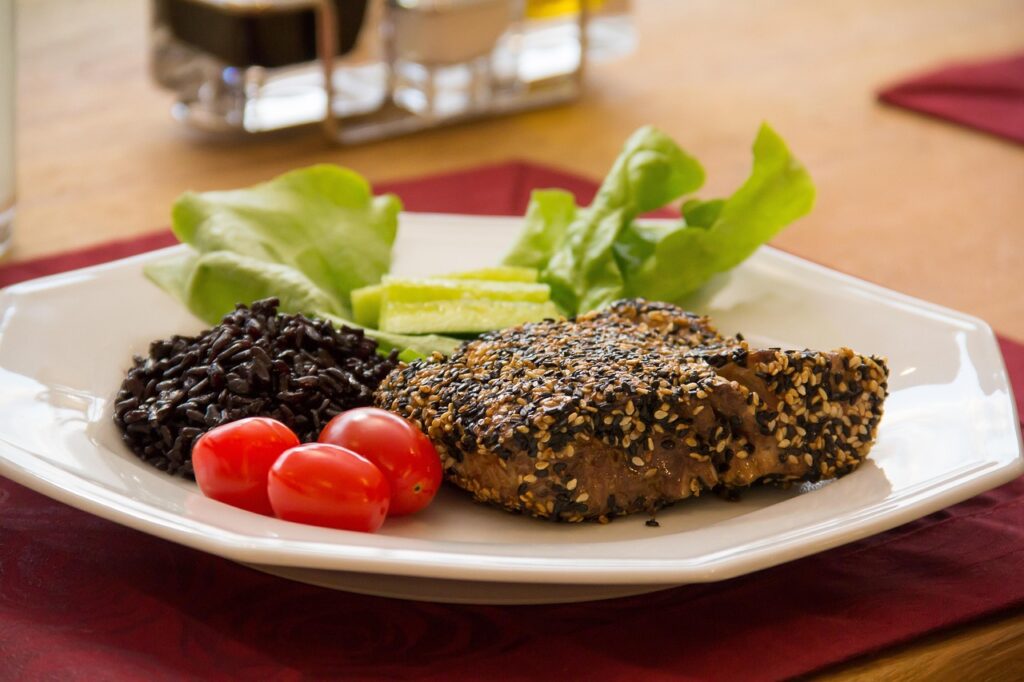
- Tuna is a lean, nutrient-dense protein — about 22 g protein per 3 oz — and a good source of omega-3s, selenium, vitamin D, and B12.
- The main caution is mercury: because tuna are large predatory fish, they accumulate more mercury than many smaller species.
- Per FDA/EPA advice, canned light tuna (usually skipjack) is a lower-mercury "Best Choice," while albacore/"white" and yellowfin are a "Good Choice" (eat less often) and bigeye is a "Choice to Avoid."
- For most healthy adults the benefits of tuna outweigh the mercury risk when eaten in reasonable amounts and varied with other fish.
- People who are pregnant or breastfeeding and young children should choose lower-mercury fish and follow FDA/EPA serving advice — including limiting albacore and avoiding bigeye.
- This is general information, not personalized advice — check the current FDA/EPA fish chart and talk to your clinician about your own situation.
Tuna is one of the most popular fish in America — affordable, high in protein, and available everywhere from sushi restaurants to grocery-store shelves. But is tuna healthy, or do mercury concerns outweigh the nutritional benefits? The honest answer is “mostly yes, with limits”: it depends on the type of tuna you eat, how often you eat it, and your individual health profile — especially whether you are pregnant, breastfeeding, or feeding young children. Here is a straightforward look at the evidence, including current FDA/EPA advice. This is general information, not personalized medical or dietary advice.
Tuna Nutrition Facts Per Serving
Tuna’s nutritional profile is impressive. A 3-ounce serving (about 85 grams) of light canned tuna packed in water contains roughly the following, according to USDA FoodData Central:
Calories: about 100. Protein: 22 grams. Total fat: 0.5 grams. Saturated fat: 0.1 grams. Omega-3 fatty acids (EPA + DHA): approximately 230 milligrams. Sodium: around 300 milligrams. Cholesterol: about 30 milligrams. Selenium: about 67 micrograms (well over 100 percent of the daily value). Vitamin D: about 1.7 micrograms. Vitamin B12: about 2.5 micrograms (roughly the full daily value). Iron: about 1.6 milligrams.
With 22 grams of protein and barely any fat, tuna ranks among the most nutrient-dense protein sources available. It is also one of the few foods that naturally provides both vitamin D and omega-3 fatty acids, which are linked to reduced inflammation, improved heart health, and better brain function, according to the Mayo Clinic.
The Mercury Concern Explained
Mercury is the primary reason people hesitate about tuna. Mercury enters the ocean from both natural sources and industrial pollution. Small organisms absorb it, and as larger fish eat smaller ones, mercury concentrates up the food chain — a process called bioaccumulation. Because tuna are large predatory fish, they tend to accumulate more mercury (as methylmercury) than smaller species. The main health concern with methylmercury is its effect on the developing nervous system, which is why the strictest advice targets pregnancy and early childhood.
Not all tuna is equal when it comes to mercury. The FDA and EPA sort fish into categories based on average mercury content. Canned light tuna (usually skipjack) is relatively low in mercury — on the order of about 0.12 parts per million (ppm) on average — and is included among the “Best Choices.” Albacore (“white”) canned tuna typically contains about three times more mercury (roughly 0.3 ppm) and falls in the “Good Choices” group, meaning eat it less often. Fresh yellowfin (ahi) is similar to albacore. Bigeye tuna is higher still (around 0.7 ppm) and is listed among the “Choices to Avoid” for those who are pregnant or breastfeeding and for young children.
For most healthy adults, the benefits of eating tuna outweigh the mercury risk when it is eaten in reasonable amounts and varied with other seafood. The key is matching the type and frequency to who you are — which is exactly what the FDA/EPA advice is designed to help you do.
FDA/EPA Advice: How Often Can You Safely Eat Tuna?
The joint FDA and EPA “Advice about Eating Fish” uses serving sizes of about 4 ounces (cooked) for adults, with smaller, age-based servings for children. A practical framework based on that advice:
- Canned light tuna (skipjack) — a “Best Choice.” Most adults can eat it regularly as part of the recommended 2 to 3 servings of lower-mercury fish per week.
- Albacore/”white” canned tuna and fresh yellowfin/ahi — a “Good Choice.” Limit to about 1 serving per week, and don’t eat other fish that same week if you are following the pregnancy/child guidance.
- Bigeye tuna — a “Choice to Avoid” for those who are pregnant or breastfeeding and for young children.
If you are pregnant or breastfeeding, the FDA and EPA recommend eating fish — 8 to 12 ounces (about 2 to 3 servings) per week of lower-mercury choices — because the omega-3s support fetal and infant brain development. Canned light tuna counts as one of those “Best Choice” options; albacore should be limited to about 1 serving per week, and bigeye should be avoided. For young children, serving sizes are smaller and depend on age (roughly 1 ounce for ages 1 to 3, increasing to about 4 ounces by ages 8 to 10), and the same “choose lower-mercury fish” principle applies. Because these recommendations are periodically updated, check the current FDA/EPA chart, and ask your obstetric or pediatric clinician about your specific situation. For a closer look at canned varieties specifically, see our article on canned tuna nutrition.
Health Benefits Beyond Protein
Tuna’s health advantages go well beyond its protein content. The omega-3 fatty acids EPA and DHA support cardiovascular health by helping lower triglycerides, modestly reducing blood pressure, and potentially decreasing the risk of irregular heart rhythms. A meta-analysis published in JAMA Internal Medicine found that consuming fish 1 to 4 times per week was associated with a lower risk of heart-disease mortality — an association, not proof that tuna alone causes the benefit.
Selenium, which tuna provides in abundance, plays a role in thyroid-hormone metabolism and acts as an antioxidant. Some research suggests selenium may partially offset mercury’s effects in the body, though this does not eliminate the need for moderation and is not a reason to ignore the mercury guidance. Tuna’s vitamin B12 content supports nerve function, DNA synthesis, and red-blood-cell formation — particularly important for older adults, who tend to absorb B12 less efficiently.
Healthier Ways to Enjoy Tuna
How you prepare tuna matters almost as much as how often you eat it. Choosing tuna packed in water rather than oil saves roughly 60 calories per serving without sacrificing protein. When making tuna salad, using Greek yogurt or avocado instead of some or all of the mayonnaise can cut saturated fat and add beneficial nutrients.
For fresh tuna, grilling or baking is preferable to deep-frying. Searing ahi tuna briefly at high heat helps preserve the omega-3 content better than prolonged cooking. Pair tuna with vegetables and whole grains — a tuna and white-bean salad over mixed greens, or tuna mixed into whole-wheat pasta with olive oil and roasted tomatoes, makes a more complete meal.
Try to avoid tuna dishes loaded with high-sodium sauces, heavy cream, or excessive cheese. A tuna melt on white bread with a thick layer of processed cheese turns a lean protein into a calorie-dense, sodium-heavy meal. Keep the focus on tuna’s natural nutritional strengths, and vary your seafood so you are not relying on tuna alone. For more ideas on building healthy meals, visit our wellness guide.
Tuna vs. Other Protein Sources
How does tuna compare? A 3-ounce serving of chicken breast provides about 26 grams of protein and 140 calories — slightly more protein but also more calories. Salmon offers about 22 grams of protein with significantly more omega-3s (roughly 1,500 milligrams versus tuna’s ~230 milligrams) but also more calories and fat, and salmon is generally lower in mercury than tuna. Compared with red meat, tuna has dramatically less saturated fat and cholesterol.
Among canned proteins, tuna stands out for convenience and cost. A can of light tuna often costs just a few dollars and provides roughly 40 grams of protein — hard to beat in terms of protein per dollar. For people looking to increase protein intake affordably, tuna is one of the better options available, as long as you keep mercury in mind and rotate in other fish.
Frequently Asked Questions
Is tuna healthy for weight loss?
Tuna is a strong weight-loss food. It is very high in protein (which promotes satiety) and very low in calories and fat — a 3-ounce serving of light tuna in water has about 100 calories. High-protein diets generally support weight loss by reducing hunger and helping preserve muscle mass during calorie restriction.
Can eating too much tuna cause mercury poisoning?
Actual mercury poisoning from tuna is very rare in adults who eat normal amounts. Symptoms of mercury toxicity — numbness, vision changes, cognitive difficulties — typically occur only with extreme, prolonged exposure. Staying within the FDA/EPA advice (favoring lower-mercury light tuna and limiting albacore and higher-mercury species) keeps exposure well within safe limits for most people. Pregnant people and young children have less margin, which is why their guidance is stricter.
Is fresh tuna healthier than canned tuna?
Fresh and canned tuna have similar nutritional profiles for protein, omega-3s, and vitamins. Fresh tuna tends to have slightly more omega-3s and less sodium (canned tuna often has added salt). However, fresh tuna — especially yellowfin and ahi — may contain more mercury than canned light tuna. Both can be healthy choices; the best option depends on your budget, convenience needs, and mercury considerations.
Is tuna safe during pregnancy?
In moderation, yes. Canned light tuna (skipjack) is a lower-mercury “Best Choice” and is considered safe during pregnancy as part of the recommended 2 to 3 servings of lower-mercury fish per week, according to the FDA and EPA. Albacore (“white”) tuna should be limited to about 1 serving per week, and bigeye tuna should be avoided. The omega-3s in tuna support fetal brain development, so moderate consumption of lower-mercury choices is beneficial — but confirm the current advice and your own plan with your prenatal clinician.
How much tuna is safe for kids?
Children can eat fish, including light tuna, but in age-appropriate serving sizes — roughly 1 ounce for toddlers, rising to about 4 ounces by around age 8 to 10 — and lower-mercury choices are best. Limit albacore and avoid the higher-mercury species. Your pediatrician can help you match amounts to your child’s age and the current FDA/EPA chart.
Tuna is a lean, protein-rich, omega-3-containing fish, but it carries mercury because it is a large predator. Favor lower-mercury canned light tuna (a “Best Choice”), eat albacore/yellowfin less often (a “Good Choice”), and avoid bigeye if you are pregnant, breastfeeding, or feeding young children — following the FDA/EPA “Advice about Eating Fish.” This is general information, not personalized advice; check the current FDA/EPA chart and talk to your clinician about your own situation, especially during pregnancy or for children.
Sources
- U.S. FDA and EPA — “Advice about Eating Fish” (Best Choices / Good Choices / Choices to Avoid chart; guidance for those who are or may become pregnant, are breastfeeding, and children ages 1–11)
- USDA FoodData Central — canned light tuna nutrition
- Mayo Clinic — omega-3 fatty acids and heart health
- JAMA Internal Medicine — fish consumption and cardiovascular-mortality meta-analysis