
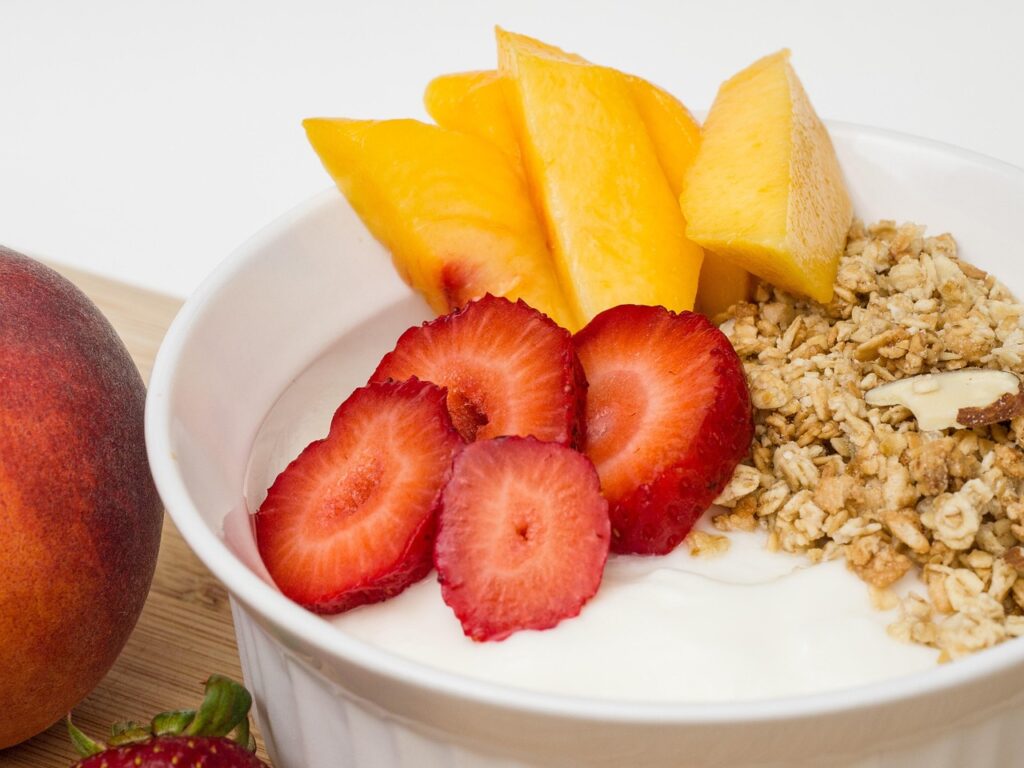
- Whether granola is "healthy" depends entirely on the product — the gap between a low-sugar, nut-heavy granola and a candy-like commercial one is large.
- Granola's upsides are real: whole-grain oats, fiber, and healthy fats from nuts and seeds can provide sustained energy.
- The main pitfalls are added sugar and calorie density; a typical half-cup runs roughly 210-300 calories and can carry 10-16 grams of sugar, much of it added.
- Portion creep is the quiet problem — most people pour far more than a half-cup, so using granola as a topping (2-3 tablespoons) rather than a base keeps calories in check.
- Read the label: look for whole oats first, added sugar around 6 grams or less per serving, fat mainly from nuts and seeds, and at least 3 grams of fiber; homemade lets you control all of it.
- This is general nutrition information, not personalized dietary advice — talk to a clinician or registered dietitian about what fits your needs.
Granola sits in the “health food” aisle and carries a wholesome reputation — but one look at the nutrition label might change your mind. Is granola healthy, or is it just a calorie-dense snack dressed up in an earthy package? The honest answer is: it depends on the product. A standard half-cup serving of commercial granola packs roughly 210 to 300 calories, 10 to 16 grams of sugar, and 6 to 12 grams of fat. That is more calorie-dense than many cereals people consider unhealthy. But granola also delivers whole grains, healthy fats, and fiber — if you choose the right kind. Here is how to separate genuinely nutritious granola from glorified candy, and how it fits within a balanced wellness plan. This is general nutrition information, not personalized advice.
Granola Nutrition: What Is Actually in There?
Granola starts with a reasonable foundation: rolled oats, which provide beta-glucan fiber, B vitamins, and minerals. According to USDA FoodData Central, a typical half-cup (about 55 grams) of commercial granola contains approximately 210 to 300 calories, 3 to 5 grams of protein, 6 to 12 grams of fat, 30 to 42 grams of carbohydrates, 2 to 4 grams of fiber, and 10 to 16 grams of sugar. These are typical ranges — exact numbers vary widely from product to product, so your specific brand’s label is what counts.
The issue is that the base oats are usually mixed with added sweeteners (honey, maple syrup, brown sugar, or agave), oils (canola, coconut, or vegetable), and calorie-dense additions like chocolate chips, dried fruit with added sugar, and candied nuts. Each of these additions pushes the calorie and sugar count higher. Compare that to plain oatmeal, which delivers similar whole-grain benefits at roughly 150 calories per cooked cup with no added sugar.
This does not mean all granola is bad. It means you need to read labels carefully. The range between a low-sugar, nut-heavy granola and a sugar-coated commercial brand is enormous — often more than a threefold difference in sugar content per serving. Granola is not a single food so much as a category that spans from genuinely nutritious to dessert-adjacent.
The Hidden Sugar Problem
Sugar is the main issue with most commercial granola. The American Heart Association (AHA) recommends no more than about 25 grams (6 teaspoons) of added sugar per day for women and about 36 grams (9 teaspoons) for men. The AHA also recommends no more than about 25 grams per day for most children ages 2-18, and no added sugar at all before age 2. A single half-cup serving of many popular granolas delivers 10 to 16 grams — a meaningful chunk of a day’s added-sugar budget before you have even finished breakfast.
Manufacturers often use multiple sweeteners so that no single one is the first ingredient on the label. You might see honey, brown rice syrup, cane sugar, and maple syrup all listed separately in the same product. Added together, sugar can be one of the most abundant ingredients by weight after oats. The FDA’s updated Nutrition Facts label now requires companies to list “Added Sugars” separately from total sugars, making it easier to tell sugar that occurs naturally (for example, in unsweetened dried fruit) from sugar that was poured in during manufacturing. Use that line — it is the single most useful number on a granola label.
Aim for granola with roughly 6 to 8 grams of added sugar per serving or less. These products exist — they just require looking past the big brands to smaller, less-marketed options, or making your own.
Calorie Density: The Portion Trap
Even a genuinely well-made granola is calorie-dense. Half a cup — roughly what fills a small handful — can hit 250 to 300 calories. Most people pour significantly more than that into a bowl, easily reaching 500 to 600 calories before adding milk or yogurt. Research on portion-size perception has repeatedly found that people underestimate serving sizes of calorie-dense foods, and granola is a classic example: it is light and crunchy, so a “normal-looking” bowl can be two or three servings.
This does not make granola inherently bad — it makes it a food that rewards portion awareness. Using granola as a topping rather than a base is one effective strategy. Sprinkle two to three tablespoons over yogurt or a smoothie bowl instead of eating it by the bowlful. This gives you the crunch, flavor, and whole-grain benefits at a fraction of the calories. Measuring a serving once, so you can see what it actually looks like in your usual bowl, is a small habit that helps.
What Makes a Granola Genuinely Healthy?
Not all granola deserves a bad reputation. A well-made granola can be a nutrient-dense food that provides sustained energy, healthy fats, and fiber. Here is a quick label checklist for what to look for.
- Whole oats (or another whole grain) as the first ingredient.
- Added sugar around 6 grams or less per serving — ideally from a single source such as a little honey or maple syrup rather than several sweeteners.
- Fat mainly from nuts and seeds (almonds, walnuts, pumpkin seeds, chia seeds) rather than added oils.
- At least 4 to 5 grams of protein per serving, mostly from nuts and seeds.
- At least 3 grams of fiber per serving.
- A short ingredient list — 10 ingredients or fewer is a reasonable benchmark.
Some of the better commercial options emphasize nuts and seeds over sweeteners. Alternatively, making granola at home is simple: toss rolled oats, nuts, seeds, and a small amount of honey or maple syrup with a tablespoon of oil, spread on a baking sheet, and bake at 325 degrees Fahrenheit for about 20 to 25 minutes, stirring once. You control every ingredient and can keep added sugar under 4 grams per serving. Homemade also lets you skip candied add-ins and choose unsweetened dried fruit.
Granola vs Other Breakfast Options
How does granola stack up against other common breakfast choices? Here is a quick comparison per typical serving (figures are approximate and vary by product).
| Breakfast (typical serving) | Calories | Sugar | Notes |
|---|---|---|---|
| Plain oatmeal (1 cup cooked) | ~150 | ~1 g | Best for blood-sugar steadiness and calorie efficiency; ~4 g fiber |
| Commercial granola (1/2 cup) | ~250-300 | ~10-16 g | Calorie-dense, but whole grains and healthy fats if chosen well |
| Energy bars such as Clif Bars | ~240-260 | ~17-22 g | Convenient but often higher in sugar than many granolas |
| Eggs (2 large) | ~140 | 0 g | Protein-forward; ~12 g protein |
| Plain Greek yogurt (1 cup) | ~130 | ~7 g (natural) | ~17 g protein; excellent paired with a small granola topping |
The most satisfying breakfast usually combines protein, fiber, and moderate carbohydrates to keep you full until lunch. Granola alone is carb-heavy and protein-light. Paired with Greek yogurt or used as a topping, it becomes part of a more balanced meal rather than the whole show.
Frequently Asked Questions
Is granola good for weight loss?
Granola can fit into a weight-management plan, but portion control is critical. Its calorie density means a large bowl can easily contain 500 to 600 calories. Use it as a topping (2 to 3 tablespoons) rather than a main dish, choose lower-sugar varieties, and account for it in your overall intake. What is right for you depends on your individual needs — a clinician or registered dietitian can help.
Is granola better than cereal?
It depends on the specific products. Many commercial cereals are lower in calories and sugar per serving than granola. However, granola made with whole oats, nuts, and minimal sugar provides more fiber, healthy fats, and sustained energy than most refined-grain cereals. Compare labels — especially the Added Sugars line and the fiber content — rather than assuming one category is universally better.
Can I eat granola every day?
For most people, yes, provided you choose a lower-sugar variety and control portions. A daily serving of 2 to 4 tablespoons as a topping on yogurt or fruit is a reasonable amount. Eating large bowls of high-sugar granola daily could contribute to excess calorie and added-sugar intake over time. Individual needs vary, so check with a clinician or dietitian if you have specific health conditions.
Is homemade granola healthier than store-bought?
Usually, yes. Homemade granola lets you control the amount and type of sweetener, avoid processed oils, and emphasize nuts and seeds. Most store-bought granola contains more added sugar and oil than a home recipe needs to taste good. Homemade also lets you tailor it to allergies or dietary preferences.
Is granola gluten-free?
Not automatically. Oats are naturally gluten-free but are frequently cross-contaminated with wheat during processing, and many granolas add wheat-based ingredients. If you need to avoid gluten, look specifically for a certified gluten-free product or make your own with certified gluten-free oats.
The Bottom Line
Granola can be healthy — but the default product on many grocery-store shelves is closer to a treat. High added sugar, calorie density, and easy-to-exceed portions are the main pitfalls, while whole grains, fiber, and nuts and seeds are the genuine upsides. Choose granola with roughly 6 grams of added sugar per serving or less, use it as a topping rather than a main course, and consider making your own to control what goes in. Treated as a crunchy accent rather than the star of the bowl, granola can earn its place in a balanced diet. This article is general information, not personalized dietary advice — for guidance tailored to you, talk to a clinician or a registered dietitian.
Whether granola is “healthy” depends on the product. Its real upsides are whole-grain oats, fiber, and healthy fats from nuts and seeds; its real pitfalls are added sugar and calorie density (a typical half-cup is ~210-300 calories with ~10-16 g sugar). Read the label — aim for whole oats first, added sugar around 6 g or less per serving, and at least 3 g fiber — and use granola as a 2-3 tablespoon topping rather than a full bowl. This is general nutrition information, not personalized advice; talk to a clinician or registered dietitian about your own needs.
Sources
- USDA FoodData Central — nutrient profiles for commercial granola and rolled oats
- American Heart Association — added-sugar recommendations (no more than about 25 g/day for women, about 36 g/day for men; no more than about 25 g/day for most children ages 2-18, and no added sugar before age 2)
- US Food and Drug Administration — updated Nutrition Facts label, including the separate “Added Sugars” line