
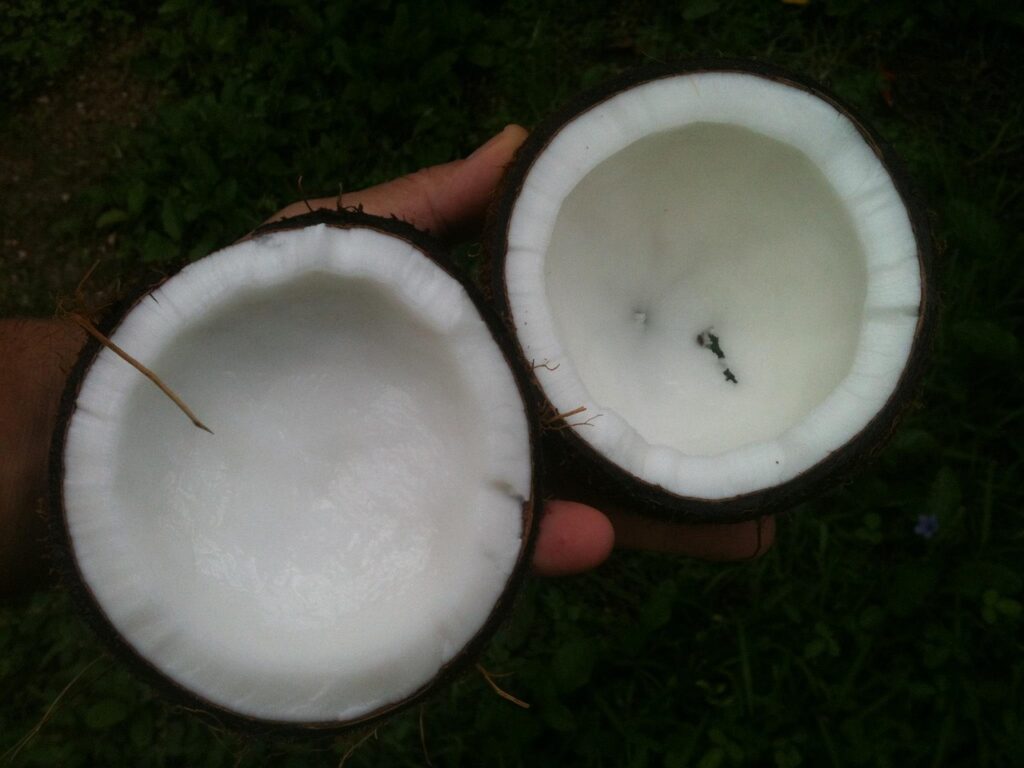
Few foods have sparked as much nutritional debate as coconut oil. Marketed as a superfood by wellness influencers and criticized as artery-clogging by cardiologists, it occupies an unusual space in the dietary landscape. Is coconut oil healthy, or has its tropical-sounding reputation outpaced the evidence? The honest answer requires separating legitimate science from marketing. Coconut oil is roughly 80 to 90 percent saturated fat — about 82 percent — which is higher than butter (around 63 percent) and lard (around 40 percent), and that puts it squarely at odds with longstanding dietary guidance from the American Heart Association (AHA). Its fatty acid profile does behave somewhat differently in the body than the fat in a steak, but that nuance has been stretched far beyond what the research supports. Here is what the evidence actually shows and how coconut oil fits into a balanced approach to nutrition.
Coconut Oil Nutrition Facts
One tablespoon (about 14 grams) of coconut oil contains roughly 121 calories, 13.5 grams of total fat, about 11 to 12 grams of saturated fat, 0.9 grams of monounsaturated fat, 0.2 grams of polyunsaturated fat, and zero protein, carbohydrate, or fiber, according to USDA FoodData Central. It contains only trace amounts of vitamin E and vitamin K and is otherwise devoid of meaningful micronutrients.
In other words, coconut oil is essentially pure fat with no protein, fiber, or notable vitamin content. Its health argument rests almost entirely on the type of fat it contains — specifically the claim that it is rich in medium-chain triglycerides (MCTs). About 45 to 55 percent of coconut oil’s fatty acids are lauric acid, a 12-carbon fatty acid that some researchers classify as an MCT and others classify as a long-chain fatty acid. That classification matters, because true MCTs (8- and 10-carbon chains) are metabolized quite differently from longer chains.
The MCT Argument: Does It Hold Up?
Medium-chain triglycerides are absorbed more quickly than long-chain fats and transported directly to the liver, where they can be used for energy rather than stored. This metabolic shortcut is the foundation of most health claims made for coconut oil. Some studies have shown that concentrated MCT oil can modestly increase calorie burning and promote a feeling of fullness.
However, there is a critical distinction that undercuts most coconut-oil marketing: coconut oil is not the same as MCT oil. Concentrated MCT oil contains primarily caprylic acid (C8) and capric acid (C10), which are rapidly metabolized. Coconut oil’s dominant fatty acid, lauric acid (C12), behaves more like a long-chain fat in absorption and metabolism. A 2017 review in the Journal of the American College of Cardiology noted that studies showing metabolic benefits of MCTs used purified MCT oil — not coconut oil — and that extrapolating those results to coconut oil is not scientifically supported.
The bottom line on MCTs: if you want the effects shown in MCT research, use MCT oil. Coconut oil delivers some medium-chain fatty acids, but not in the form or concentration that the positive studies used. This is the central reason the “coconut oil is a metabolism-boosting health fat” narrative is overstated.
Coconut Oil and Cholesterol: What the AHA Says
This is where the debate gets heated — and where the evidence is clearest. The AHA’s 2017 advisory on dietary fats specifically advised against using coconut oil, citing evidence that it raises LDL cholesterol, a well-established risk factor for cardiovascular disease. The advisory noted that coconut oil raised LDL in seven controlled trials, and that because it raises LDL like other saturated fats, it should not be viewed as heart-healthy. The AHA’s broader guidance is to limit saturated fat and replace it with unsaturated fats.
Coconut oil proponents counter that it also raises HDL (the “good” cholesterol), improving the total-to-HDL ratio. A 2020 meta-analysis published in Circulation confirmed both observations: coconut oil significantly raised both LDL and HDL compared with non-tropical vegetable oils. But raising HDL through diet has not been shown to lower cardiovascular risk the way lowering LDL does, and most major health organizations continue to recommend limiting coconut oil because of its LDL-raising effect. Harvard’s Nutrition Source reaches the same practical conclusion: coconut oil can be used sparingly for flavor, but it should not be a go-to oil, and it is not a substitute for oils rich in unsaturated fat.
For context, replacing coconut oil with olive oil or canola oil consistently lowers LDL cholesterol in controlled studies. If heart disease risk is a concern — and heart disease is the leading cause of death in the United States — the substitution math favors unsaturated oils. Our guide on how to lower cholesterol naturally covers this in more depth.
How Much Saturated Fat Is Too Much?
MedlinePlus notes that the Dietary Guidelines for Americans recommend limiting saturated fat to less than 10 percent of daily calories — about 22 grams on a 2,000-calorie diet — and it lists coconut oil among the solid fats that are high in saturated fat. The AHA is stricter, suggesting that people who would benefit from lowering cholesterol aim for about 5 to 6 percent of calories from saturated fat, roughly 13 grams on a 2,000-calorie diet. Either way, one tablespoon of coconut oil (about 11 to 12 grams of saturated fat) uses up most or all of that day’s budget, which is exactly why “add coconut oil to everything” is poor advice.
Coconut Oil vs Other Cooking Oils
How does coconut oil stack up against common alternatives, per tablespoon? Extra virgin olive oil has about 119 calories and roughly 2 grams of saturated fat with 10 grams of monounsaturated fat, and it has strong evidence for cardiovascular benefits; its smoke point (around 375 to 410°F) suits low-to-medium-heat cooking, dressings, and finishing. Canola oil has about 124 calories and 1 gram of saturated fat with a neutral flavor and a higher smoke point (around 400°F). Avocado oil has about 124 calories, 1.6 grams of saturated fat, and a very high smoke point (around 520°F), making it excellent for high-heat cooking. Butter has about 102 calories and 7.3 grams of saturated fat. Coconut oil has about 121 calories and 11 to 12 grams of saturated fat — the highest of any common cooking fat.
Coconut oil’s smoke point is moderate (around 350°F for virgin, 400°F for refined). It does have a longer shelf life than many unsaturated oils because saturated fats are more resistant to oxidation, and its semi-solid state at room temperature makes it a workable butter substitute in vegan baking. Those are practical properties, not health advantages.
Legitimate Uses for Coconut Oil
While its health claims are overstated, coconut oil is not without value. It works well in specific culinary applications: Thai and Southeast Asian cooking where coconut flavor is desirable, vegan baking as a butter substitute, high-heat sautéing with refined coconut oil, and no-bake recipes where a binding fat is needed.
Outside the kitchen, coconut oil has well-supported cosmetic uses as a skin moisturizer and hair conditioner. A study in the Journal of Cosmetic Science found that coconut oil reduced protein loss in hair better than mineral oil or sunflower oil. Dermatologists sometimes recommend it for mild dry skin, though it can clog pores and worsen acne in some people.
If you enjoy coconut oil in cooking, using it occasionally in small amounts is unlikely to harm your health. The problem arises when people replace olive oil or other unsaturated fats with coconut oil as their primary cooking fat, or when they add tablespoons of it to coffee or smoothies daily under the belief that it is a health food. Neither practice is supported by evidence. This is a classic “health halo” — a food’s exotic image and a kernel of truth about MCTs get inflated into claims the science does not back. For more on separating reputation from evidence, see whether dark chocolate and granola deserve their health-food status.
Frequently Asked Questions
Is coconut oil better than butter?
Coconut oil contains more saturated fat than butter (about 82 percent vs 63 percent), but as a plant fat it has no dietary cholesterol. Both raise LDL cholesterol compared with unsaturated oils. Neither is a health food, and neither must be completely avoided. For cardiovascular health, unsaturated oils like olive oil are the better choice over both.
Does coconut oil help with weight loss?
Studies on concentrated MCT oil — not coconut oil specifically — have shown modest increases in calorie expenditure and satiety. Coconut oil is calorie-dense at about 121 calories per tablespoon, and adding it without cutting equivalent calories elsewhere leads to weight gain, not loss. There is no credible evidence that coconut oil is a weight-loss aid.
Is virgin coconut oil healthier than refined?
Virgin (unrefined) coconut oil retains more polyphenol antioxidants and has a distinct coconut flavor and aroma; refined coconut oil is more processed, with a neutral taste and higher smoke point. Their fatty acid profiles are nearly identical, so the modest antioxidant edge of virgin oil does not change the fundamental saturated-fat concern.
How much coconut oil per day is safe?
The AHA suggests limiting saturated fat to about 5 to 6 percent of calories (roughly 13 grams on a 2,000-calorie diet), and one tablespoon of coconut oil contains nearly that entire amount. If you use coconut oil, keep it to about one tablespoon per day or less and minimize other saturated-fat sources on the same day. People with high cholesterol or heart disease should ask their clinician about their own targets.
Is coconut oil good for your heart?
Based on current evidence, no — it raises LDL cholesterol, and the AHA advises against using it for cardiovascular health. Unsaturated oils such as olive, canola, and avocado are the heart-healthier choices. If you have heart disease or elevated cholesterol, talk with your doctor before making coconut oil a regular part of your diet.
The Bottom Line
Coconut oil is not the superfood the wellness industry portrays, but it is not poison either. It raises both LDL and HDL cholesterol, its fatty acid profile differs from animal-based saturated fats, and it has legitimate culinary and cosmetic uses. What it is not is a substitute for olive oil or other unsaturated fats backed by decades of cardiovascular research, and the MCT-based “metabolism booster” claims do not transfer from purified MCT oil to coconut oil. Use coconut oil when its flavor or texture is genuinely needed, keep portions small, and ignore the claim that more is better. The healthiest fat strategy is variety centered on unsaturated oils — and coconut oil can be, at most, one small part of that rotation.
TL;DR: Coconut oil is about 80-90% saturated fat and raises LDL cholesterol, so the American Heart Association advises against using it for heart health and recommends unsaturated oils (olive, canola, avocado) instead. It is mostly lauric acid, not the C8/C10 MCTs behind popular “metabolism-boosting” claims, so those benefits do not transfer. Occasional small culinary use and cosmetic use are fine; it is not a health tonic and should not replace unsaturated cooking oils. Keep total saturated fat low (AHA: about 5-6% of calories, roughly 13 g/day on 2,000 calories).
Medical disclaimer: This article is educational information and not medical or nutrition advice. Cholesterol targets and dietary needs vary by individual. If you have heart disease, high cholesterol, or other health conditions, talk with your physician or a registered dietitian before making dietary changes. Nutrition figures are estimates that vary by source — verify current values as needed.
Sources
- American Heart Association — Saturated Fat and the 2017 Presidential Advisory Dietary Fats and Cardiovascular Disease (advises against coconut oil; limit saturated fat)
- MedlinePlus (U.S. National Library of Medicine) — Facts about saturated fats (coconut oil listed as high-saturated-fat solid fat; limit to less than 10% of calories)
- U.S. Department of Agriculture — FoodData Central (coconut oil and cooking-oil nutrition)
- Harvard T.H. Chan School of Public Health, The Nutrition Source — Coconut Oil