
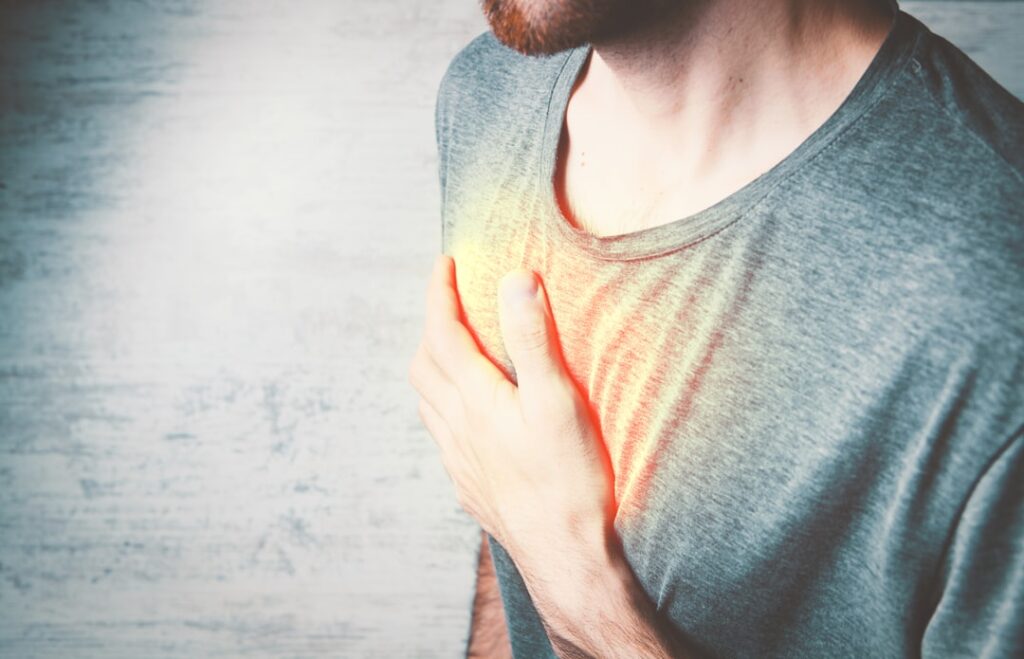
Call 911 now if chest tightness comes with any of these: pressure, squeezing, or pain in the chest — especially with shortness of breath; pain spreading to the arm, jaw, neck, back, or upper abdomen; cold sweat, nausea, or vomiting; lightheadedness, fainting, or a sense of impending doom. These can mean a heart attack. Sudden, severe chest tightness with breathlessness — particularly after surgery, a long flight, or a leg clot — can mean a pulmonary embolism, and sudden tearing chest or back pain can signal an aortic emergency. Do not drive yourself. Call 911 and let emergency dispatchers guide you; they may advise chewing aspirin if it is safe for you. When in doubt, call — a false alarm is always safer than a missed heart attack.
Chest tightness sends millions of Americans to the emergency room every year, and for good reason. It can signal a heart attack, a pulmonary embolism, or a panic attack, and in the moment, telling them apart feels impossible. Understanding when to worry about chest tightness starts with recognizing the key features that distinguish a life-threatening emergency from a frightening but benign episode. The short answer: if you are unsure, seek medical attention immediately. The cost of a false alarm is always less than the cost of a missed heart attack. This article is part of our medical conditions guide and aims to help you make informed decisions about your symptoms. It is not a substitute for evaluation by a clinician.
The bottom line up front: Chest tightness has dozens of causes, from a pulled muscle to a heart attack. You cannot reliably tell the dangerous ones apart at home, so the safe rule is simple — treat new, severe, or unexplained chest tightness as a possible emergency until a clinician says otherwise. Call 911 for the red flags above. For milder, reproducible, or long-standing tightness with no alarm features, still get it checked, just not necessarily by ambulance.
Heart-Related Chest Tightness: Warning Signs
Cardiac chest tightness is the symptom that most people fear, and rightly so. About 805,000 people in the United States have a heart attack each year, according to the CDC, and heart disease remains the nation’s leading cause of death. Recognizing the pattern of cardiac chest tightness can save your life.
Heart attack chest tightness is typically described as a squeezing, pressing, or heavy sensation in the center or left side of the chest. Patients often describe it as an elephant sitting on their chest or a vise grip being tightened. The sensation may radiate to the left arm, jaw, neck, back, or upper abdomen. It usually lasts more than a few minutes or comes and goes in waves.
Associated symptoms that increase the likelihood of a cardiac cause include shortness of breath, cold sweats, nausea or vomiting, lightheadedness, and a sense of impending doom. Chest tightness that occurs with exertion and improves with rest is a classic pattern for angina, which indicates that the heart muscle is not receiving enough blood flow during periods of increased demand. Angina that is new, happens at rest, or is worsening (sometimes called unstable angina) is an emergency and should be treated like a possible heart attack.
Women, older adults, and people with diabetes may experience less typical presentations, and this is a critical point: the absence of dramatic crushing pain does not rule out a heart attack. According to the Mayo Clinic, women are more likely than men to have atypical symptoms including jaw pain, back pain, nausea, shortness of breath, and extreme fatigue without the classic chest pressure. People with diabetes may have blunted pain signals and can have a “silent” heart attack. If you fall into one of these groups, lower your threshold for seeking care. If you are concerned about heart-related symptoms, our article on when to worry about heart palpitations covers another common cardiac concern.
When to seek emergency care: Call 911 immediately if you experience chest tightness with shortness of breath, pain radiating to the arm, jaw, or back, cold sweats, nausea, dizziness, or if the tightness lasts more than a few minutes. Do not drive yourself to the hospital. Emergency dispatchers may advise you to chew aspirin while you wait for the ambulance, but only do so if they instruct you to and you are not allergic and have no condition that makes it unsafe — let the professionals make that call rather than dosing yourself.
Lung-Related Causes of Chest Tightness
The lungs and their surrounding structures can produce chest tightness that mimics or overlaps with cardiac symptoms. Several lung causes are emergencies in their own right.
Pulmonary Embolism
A blood clot in the lungs is a medical emergency that produces sudden chest tightness, sharp chest pain that worsens with deep breathing, shortness of breath, rapid heartbeat, and sometimes coughing up blood. Risk factors include recent surgery, prolonged immobility (such as a long flight or hospital stay), cancer, pregnancy and the postpartum period, estrogen-containing contraceptives, and a personal or family history of blood clots. Pulmonary embolism is estimated to cause as many as 100,000 deaths in the United States each year, making rapid recognition critical. If you are also concerned about clots elsewhere, see our guide on symptoms of a blood clot. Do not try to “wait and see” with sudden breathlessness and chest tightness — call 911.
Asthma
Asthma-related chest tightness feels like a band constricting around the chest. It is accompanied by wheezing, coughing, and difficulty exhaling. Triggers include allergens, exercise, cold air, and respiratory infections. The tightness typically responds to bronchodilator medications (rescue inhalers) prescribed by your clinician. If you have known asthma and your usual medications are not relieving symptoms, if you are struggling to speak in full sentences, or if your lips or fingertips look blue, treat it as an emergency and seek care immediately.
Pneumonia and Pleurisy
Lung infections can cause chest tightness along with fever, cough, and sharp pain that worsens with breathing or coughing. Pleurisy, inflammation of the membrane surrounding the lungs, produces a distinctive sharp, stabbing pain with each breath. The pain is typically localized and worsens with deep inhalation, coughing, or sneezing. High fever, worsening breathlessness, or confusion warrants urgent evaluation.
Pneumothorax
A collapsed lung causes sudden onset chest tightness and sharp pain on one side of the chest, with shortness of breath. It can occur spontaneously, particularly in tall, thin young men, or after chest trauma. This requires emergency medical attention.
Anxiety and Panic-Related Chest Tightness
Anxiety is one of the most common causes of chest tightness, particularly in younger adults. Panic attacks produce chest symptoms that can be virtually indistinguishable from cardiac events in the moment, which is why so many anxious patients end up in the emergency room and why that is often the right decision.
Anxiety-related chest tightness typically involves a feeling of tightness or constriction across the chest, difficulty taking a satisfying deep breath, tingling or numbness in the hands and face, rapid heartbeat, hyperventilation, and a feeling of unreality or impending doom. The episode usually peaks within about 10 minutes and eases within 20 to 30 minutes, though residual anxiety and chest awareness can persist for hours.
Here is the essential safety message: anxiety is a diagnosis of exclusion. The symptoms of a panic attack and a heart attack overlap substantially, and the two can coexist. Research indexed on PubMed suggests that a substantial share of patients who come to the ER with chest pain are ultimately found to have a primary anxiety or panic disorder — but that determination is made only after cardiac and pulmonary causes have been properly ruled out with testing. Never self-diagnose chest tightness as “just anxiety,” especially if you have cardiac risk factors, if the symptoms are new, or if they differ from your usual panic episodes. If you have already been told in the past that a symptom was a red flag, do not talk yourself out of getting checked again.
Musculoskeletal Causes
The chest wall contains muscles, cartilage, ribs, and nerves that can all produce tightness and pain. Costochondritis, inflammation of the cartilage connecting the ribs to the breastbone, is one of the most common causes of chest wall pain in adults. It produces a sharp or pressing pain in the front of the chest that worsens with deep breathing, coughing, or pressing on the affected area.
Muscle strain from exercise, heavy lifting, or even prolonged coughing can cause chest tightness. The pain is typically reproducible, meaning you can make it worse by pressing on the area or moving in specific ways. It tends to be localized rather than diffuse, and it may improve with rest, over-the-counter anti-inflammatory medication used as directed, and heat or ice.
Musculoskeletal chest tightness, while uncomfortable, is usually not dangerous. The key distinguishing features are tenderness to touch, reproduction of pain with specific movements, and absence of associated symptoms like shortness of breath, sweating, or radiation to the arm or jaw. Still, tenderness to the touch does not guarantee the cause is benign — a heart attack can occasionally coexist with a sore chest wall — so if you have risk factors or alarm symptoms, get evaluated.
Gastrointestinal Causes
Digestive conditions are a surprisingly common cause of chest tightness and pain. Gastroesophageal reflux disease (GERD) produces a burning sensation and tightness behind the breastbone that can closely mimic angina. Acid reflux tightness often worsens after eating, when lying down, or when bending over, and it may respond to antacids.
Esophageal spasm causes sudden, intense chest tightness or pain that can feel identical to a heart attack. The esophagus runs directly behind the heart, and the nerve pathways overlap, making differentiation difficult without medical testing. Esophageal spasm pain may even ease with nitroglycerin, just as angina does, which can further confuse the picture — another reason not to self-diagnose.
According to the Cleveland Clinic, a large share of patients evaluated for chest pain ultimately receive a non-cardiac diagnosis, with GERD and esophageal disorders being among the most common alternatives. But “common” is not the same as “certain,” and reflux is a diagnosis your clinician makes after dangerous causes are excluded, not one to assume in the middle of an episode.
How Doctors Determine the Cause
When you present with chest tightness, healthcare providers follow a systematic approach to quickly rule out life-threatening causes. An electrocardiogram (ECG), completed in minutes, checks for heart attack or dangerous arrhythmias. Blood tests including high-sensitivity troponin detect heart muscle damage. A chest X-ray evaluates the lungs for pneumonia, collapsed lung, and fluid. If pulmonary embolism is suspected, a D-dimer blood test and CT pulmonary angiography may be ordered.
If initial testing is normal, additional evaluation may include stress testing, echocardiography, or cardiac CT to assess coronary artery disease. For recurrent chest tightness without a clear cardiac cause, evaluation for GERD, esophageal disorders, and anxiety may be pursued. This stepwise, “rule out the dangerous things first” approach is exactly why you should not attempt to self-triage a serious episode at home.
A Practical Decision Framework
This framework is not a substitute for medical judgment, but it can help you calibrate your response when when to worry about chest tightness becomes personal.
Call 911 immediately if chest tightness is accompanied by pain radiating to the arm or jaw, shortness of breath at rest, cold sweats, nausea, sudden onset with risk factors for a blood clot, fainting or near-fainting, or a sense of doom. Seek same-day care if chest tightness is new and persistent, if it occurs with exertion and resolves with rest, if you have cardiovascular risk factors (smoking, diabetes, high blood pressure, high cholesterol, family history), or if you have new chest symptoms while taking estrogen-containing contraceptives.
Schedule a prompt appointment if chest tightness is reproducible with pressing on the chest wall, if it consistently occurs with stress and resolves when you calm down, if it worsens after eating and responds to antacids, or if it has been present unchanged for months without associated symptoms. When categories are unclear — and they often are — round up to the more cautious option.
Frequently Asked Questions
How do I know if chest tightness is a heart attack?
Heart attack chest tightness typically involves a squeezing or pressure sensation in the center of the chest lasting more than a few minutes, often with radiation to the arm, jaw, or back, and associated with shortness of breath, sweating, or nausea. However, presentations vary widely, and women, older adults, and people with diabetes can have atypical or subtle symptoms. When in doubt, call 911. It is always better to be evaluated and reassured than to delay treatment for an actual heart attack.
Can anxiety cause chest tightness every day?
Yes. Chronic anxiety and hyperventilation can produce daily chest tightness. However, daily chest tightness should not be attributed to anxiety without medical evaluation to rule out cardiac, pulmonary, and gastrointestinal causes. Once those are excluded, anxiety management through therapy, breathing techniques, and sometimes medication prescribed by a clinician can effectively reduce symptoms.
Is chest tightness without pain serious?
Chest tightness without sharp pain can still indicate a serious condition, including a heart attack. Many patients, particularly women, older adults, and people with diabetes, experience pressure or tightness rather than outright pain during a cardiac event. The absence of pain does not rule out a dangerous cause, especially when other symptoms like shortness of breath, sweating, or dizziness are present.
Why does my chest feel tight at night?
Nighttime chest tightness is commonly caused by GERD (lying flat allows acid to reflux), asthma (symptoms often worsen at night), anxiety, or sleeping in a position that strains chest wall muscles. But nighttime tightness can also be unstable angina. If nighttime chest tightness is new, persistent, or wakes you from sleep — especially with breathlessness or sweating — treat it as a possible emergency and seek care.
When should I worry about chest tightness during exercise?
Chest tightness that consistently occurs during physical exertion and resolves within a few minutes of stopping is a classic pattern for exercise-induced angina and requires prompt cardiovascular evaluation. If it comes on during exercise in anyone over 40 or with cardiac risk factors, stop, do not “push through it,” and get evaluated before exercising again. Tightness that continues at rest after you stop is a 911 situation.
The Bottom Line
Chest tightness has dozens of possible causes, ranging from the trivial to the life-threatening. The most important rule is simple: when in doubt, seek medical attention. An ER evaluation for chest tightness that turns out to be acid reflux or a panic attack is not a waste of time. It is the appropriate, responsible thing to do. Once serious causes are ruled out, you and your doctor can work together to identify and manage the actual source, whether that is GERD, anxiety, costochondritis, or something else. Never gamble with chest symptoms, and never let a past reassurance stop you from getting a new or worsening episode checked.
This article is for general educational purposes only and is not medical advice, diagnosis, or treatment. It cannot account for your individual medical history. If you are having chest tightness with any warning sign described above, call 911 or your local emergency number. For non-emergency concerns, consult a licensed clinician.
Sources
- Centers for Disease Control and Prevention — Heart disease and heart attack facts and statistics: cdc.gov/heart-disease
- Mayo Clinic — Heart attack symptoms and causes: mayoclinic.org
- Cleveland Clinic — Chest pain and non-cardiac causes: clevelandclinic.org
- National Library of Medicine / PubMed — Research on chest pain and panic disorder in emergency settings: pubmed.ncbi.nlm.nih.gov