
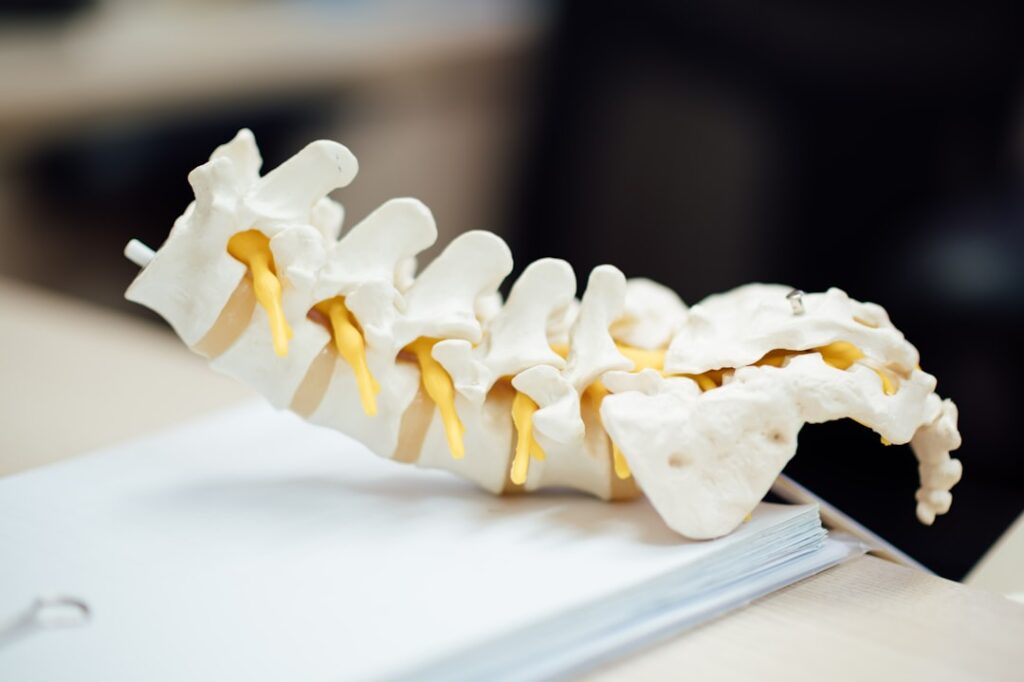
The C5-C6 level is the most common location for cervical disc problems, bearing more stress than almost any other segment of the neck. Symptoms of bulging disc in neck C5-C6 range from localized neck stiffness to radiating arm pain, numbness, and weakness — depending on whether the disc is simply protruding or actively compressing a nerve root or the spinal cord. According to the American Academy of Orthopaedic Surgeons, the C5-C6 and C6-C7 levels account for a large share of all cervical disc herniations.
Quick summary: A C5-C6 bulging disc most often irritates the C6 nerve root, producing neck pain that radiates down the outer arm toward the thumb and index finger, with numbness, tingling, and sometimes weakness. Most cases improve with conservative care such as physical therapy over several weeks to a few months, and only a minority need surgery. The important exception is cervical myelopathy (spinal cord compression), which is a red flag that needs urgent evaluation. This article is educational and does not replace an in-person assessment by a clinician.
Many bulging discs produce no symptoms at all — MRI studies show disc bulges in a large proportion of adults over 40 who have zero neck pain, and these rates rise steadily with age. But when a C5-C6 bulge does become symptomatic, it creates a recognizable pattern that guides diagnosis and treatment.
Understanding the C5-C6 Disc
Your cervical spine consists of seven vertebrae, and between each pair sits a disc — a tough outer ring (annulus fibrosus) surrounding a gel-like center (nucleus pulposus). These discs act as shock absorbers and allow flexible movement of the neck.
A bulging disc occurs when the annulus weakens and the disc extends beyond its normal boundary, like a hamburger patty that is slightly too wide for the bun. This differs from a herniated disc, where the outer ring actually tears and inner material pushes through. A bulging disc can, however, progress to a herniation, and both can compress nearby nerve roots or the spinal cord.
The C5-C6 segment is particularly vulnerable because it sits at a biomechanical transition point — an area of substantial cervical flexion and extension. Every time you look down at your phone or up at a ceiling, the C5-C6 disc bears a disproportionate share of the load. The National Library of Medicine notes that degenerative changes at this level are nearly universal in older adults, and that most such changes are a normal part of aging rather than a disease.
Key Symptoms of a C5-C6 Bulging Disc
When a bulging disc at C5-C6 causes symptoms, the C6 nerve root is typically the one affected. This creates a specific pattern of pain, numbness, and weakness.
Neck Pain and Stiffness
A deep, aching pain in the back or side of the neck is often the initial symptom. Stiffness may limit your ability to turn your head or tilt it backward. The pain can be constant or intermittent, and certain positions — looking up, tilting your head toward the affected side — tend to worsen it. Morning stiffness is common because the disc absorbs fluid overnight and becomes slightly larger, increasing pressure.
Radiating Arm Pain
When the bulging disc compresses the C6 nerve root, pain typically radiates from the neck through the shoulder and down the outer aspect of the upper arm, into the forearm, and toward the thumb and index finger. Many people describe this as a burning, electric, or shooting pain. It can be intermittent or constant, and often intensifies with neck extension or rotation toward the affected side.
Numbness and Tingling
The C6 nerve root supplies sensation to the thumb and index finger, as well as the outer forearm. Numbness, tingling, or a “pins and needles” sensation in these areas is characteristic of C5-C6 compression. Some patients describe the thumb feeling “thick” or “asleep.”
Weakness
The C6 nerve root helps power the biceps muscle and the wrist extensors. Compression may produce weakness in elbow flexion (bending the arm) and wrist extension (pulling the hand back). You might notice difficulty opening jars, carrying bags, or performing a biceps curl. A diminished biceps reflex is a clinical sign your doctor may detect during examination.
Muscle Spasms
The neck and upper back muscles often spasm in response to a disc problem, acting as a protective splint. These spasms can be painful in their own right and may cause headaches radiating from the base of the skull. The Mayo Clinic notes that muscle spasms frequently accompany disc-related neck pain and can sometimes be the dominant symptom.
The C6 Nerve Root Pattern at a Glance
| Feature | Typical C6 (C5-C6) pattern |
|---|---|
| Pain path | Neck to outer shoulder, outer arm and forearm, toward thumb |
| Numbness/tingling | Thumb and index finger, outer forearm |
| Weakness | Elbow flexion (biceps), wrist extension |
| Reflex change | Reduced biceps and/or brachioradialis reflex |
Patterns overlap between levels, so only a clinician can confirm which nerve root is involved; this table is a general guide, not a self-diagnosis tool.
Cervical Myelopathy: When the Spinal Cord Is Involved
A large bulging or herniated disc at C5-C6 can compress not just the exiting nerve root but the spinal cord itself — a condition called cervical myelopathy. This is more serious than a pinched nerve and needs prompt evaluation, because untreated cord compression can cause permanent neurological damage.
Unlike simple radiculopathy, which usually improves on its own, myelopathy tends to progress over time and often requires surgical decompression to halt or slow it. The Cleveland Clinic and spine surgery societies emphasize that early recognition matters, because outcomes are generally better when the cord is decompressed before severe deficits set in.
Cervical myelopathy red flags — get an urgent evaluation: See a doctor promptly (same day, and ask specifically about a neurosurgical or spine-surgery referral) if you notice progressive weakness in the arms or legs, new hand clumsiness such as dropping objects or trouble with buttons, handwriting, or picking up coins, problems with balance or an unsteady, wide-based gait, a feeling of heaviness in the legs, electric shock-like sensations running down your spine when you bend your neck forward (Lhermitte’s sign), or any change in bowel or bladder control. Call 911 or go to the nearest emergency room for sudden severe weakness or numbness in the arms or legs, new loss of bladder or bowel control, or severe neck pain after trauma such as a car crash or fall.
What Causes a Bulging Disc at C5-C6?
Several factors contribute to disc degeneration and bulging at this level.
Age-related degeneration. Discs lose water content and elasticity over time, making them more susceptible to bulging. This process typically accelerates after about age 30 and is a major reason disc problems become more common with age.
Repetitive strain. Occupations requiring prolonged neck flexion (desk work, dentistry, surgery) or repetitive neck movements subject the C5-C6 disc to cumulative stress. “Tech neck” — the forward-head posture from extensive phone and computer use — places additional load on this segment. Biomechanical models suggest that the further the head drifts forward from a neutral position, the greater the effective load on the cervical spine, which is one reason posture is emphasized in prevention.
Trauma. Whiplash injuries from car accidents, falls, and sports impacts can damage the disc structure acutely or create micro-tears that progress over time.
Genetics. Twin and family studies indexed in PubMed have identified genetic contributions to disc degeneration, including variations in collagen and proteoglycan genes. A family history of disc disease increases your risk.
Diagnosis
Your doctor will begin with a thorough history and physical examination. Specific tests — like the Spurling test (applying downward pressure to the head while it is tilted to one side) — can reproduce nerve root symptoms and help localize the problem. Reflex testing, sensation assessment, and strength evaluation round out the clinical exam. Your clinician will also check for signs of myelopathy, such as an abnormal gait or brisk reflexes.
Imaging confirms the diagnosis when needed. MRI is the gold standard, providing detailed views of the disc, nerve roots, and spinal cord. X-rays may show disc-space narrowing or bone spurs but cannot visualize soft tissue well. CT myelography (a CT scan performed after dye is injected into the spinal fluid) is an alternative for patients who cannot have an MRI. Electromyography (EMG) and nerve conduction studies may be ordered if the clinical picture is unclear, as they assess nerve function directly. Because harmless disc bulges are so common on imaging, findings are always interpreted alongside your symptoms rather than in isolation.
Treatment Options
Conservative treatment successfully manages symptoms of bulging disc in neck C5-C6 in the large majority of patients. Surgical intervention is generally reserved for cases that fail conservative care or involve progressive neurological deficits or spinal cord compression.
Conservative Care (First 6-12 Weeks)
Over-the-counter anti-inflammatory medications and other pain relievers are commonly used to reduce pain and inflammation, and a clinician may consider a short course of prescription medication for severe symptoms. Any medication choice, dose, and duration should be directed by a clinician who knows your health history, especially if you have kidney, stomach, heart, or bleeding concerns. Activity modification — avoiding positions that worsen pain and taking breaks from sustained neck postures — is important, but this does not mean strict bed rest, which can actually slow recovery.
Physical therapy is the cornerstone of conservative treatment. A cervical-focused program includes gentle cervical traction (which can open the foraminal spaces and reduce nerve compression), strengthening for the deep cervical flexors and scapular stabilizers, postural correction, and manual therapy. Directional (McKenzie-style) exercises, which use specific movements to reduce disc-related symptoms, help many patients. A therapist tailors the program to your presentation and adjusts it if any movement reproduces your radiating arm symptoms.
Injections
Cervical epidural steroid injections deliver anti-inflammatory medication near the affected nerve. They provide meaningful relief for a substantial share of patients and can serve as both a therapeutic and diagnostic tool. The number and frequency of injections are decided by the treating physician based on response and safety considerations.
Surgical Options
When conservative treatment fails after an adequate trial, or when myelopathy or progressive weakness is present, surgery becomes appropriate. Anterior cervical discectomy and fusion (ACDF) — removing the damaged disc and fusing the adjacent vertebrae — is the most common procedure for C5-C6 disc problems and has high success rates for relieving arm pain. Cervical disc replacement (artificial disc) is an alternative that preserves motion at the treated level and may reduce stress on adjacent segments. A spine surgeon can explain which option fits your anatomy and goals.
When to See a Doctor
Schedule an appointment if your neck pain persists beyond about two weeks without improvement, if you develop numbness or tingling in your arm or hand, if weakness makes daily tasks difficult, or if the pain significantly disrupts your sleep. A pain management doctor or spine specialist can provide targeted evaluation and treatment. Seek care sooner — and mention the myelopathy red flags above — if you notice hand clumsiness, balance problems, or any bowel or bladder changes.
For related spine conditions, you may also want to read about sciatica symptoms, which involve similar disc-related nerve compression in the lower back.
Frequently Asked Questions
Can a bulging disc in the neck heal on its own?
Many bulging discs improve significantly with time and conservative treatment. The body can partially reabsorb herniated disc material through a process called resorption, and inflammation around the nerve root typically decreases over weeks to months. While the structural bulge may remain visible on imaging, symptoms often resolve as inflammation subsides and the nerve adapts. Interestingly, larger herniations sometimes resorb more than smaller bulges. This favorable natural history applies to nerve-root symptoms — not to myelopathy, which usually needs formal evaluation.
Is it safe to exercise with a C5-C6 bulging disc?
Gentle exercise is generally safe and beneficial. Walking, swimming, and specific physical therapy exercises can improve symptoms and support recovery. It is wise to avoid heavy overhead lifting, high-impact activities, and exercises that require sustained neck extension (such as a military press) until cleared. Any movement that reproduces or intensifies your radiating arm symptoms should be modified or stopped. A physical therapist can design a safe, progressive program tailored to your symptoms.
What’s the difference between a bulging disc and a herniated disc?
A bulging disc extends beyond its normal boundary without a tear in the outer ring — the disc protrudes broadly, like a slightly deflated tire. A herniated disc involves an actual tear in the annulus fibrosus, allowing the gel-like nucleus to push through. Herniations tend to produce more focal, intense nerve compression and are more likely to cause significant radiculopathy symptoms. That said, both can cause identical symptoms if they compress a nerve root to the same degree.
Will I need surgery for a C5-C6 disc problem?
Most people do not. Only a minority of cervical disc patients ultimately require surgery. It is generally recommended when conservative treatment fails after an adequate trial, when progressive neurological deficits develop (worsening weakness or numbness), or when signs of spinal cord compression (myelopathy) are present. If your symptoms are stable or improving with conservative care, surgery is unlikely to be necessary.
How long does a C5-C6 bulging disc take to get better?
Timelines vary, but many people with nerve-root symptoms notice meaningful improvement over roughly six to twelve weeks of conservative care, and a majority recover without surgery. Recovery can be slower with more severe compression or if aggravating habits continue. Progressive or new neurological symptoms should prompt reassessment rather than continued waiting.
Proactive Steps for Neck Health
Whether you are currently managing C5-C6 symptoms or looking to prevent them, daily habits make a difference. Maintain a neutral neck posture during screen use (screen at eye level, phone held higher). Take posture breaks every 30 minutes or so during sedentary work. Strengthen your deep neck flexors and upper back muscles through targeted exercises. Sleep with a supportive pillow that keeps the neck aligned. Stay generally well hydrated, since disc hydration depends on whole-body hydration. These strategies will not reverse structural disc changes, but they can reduce symptom burden and may slow progression. For more on spine and nerve conditions, visit our medical conditions guide. Use this article to prepare for a conversation with a clinician rather than as a substitute for one.