
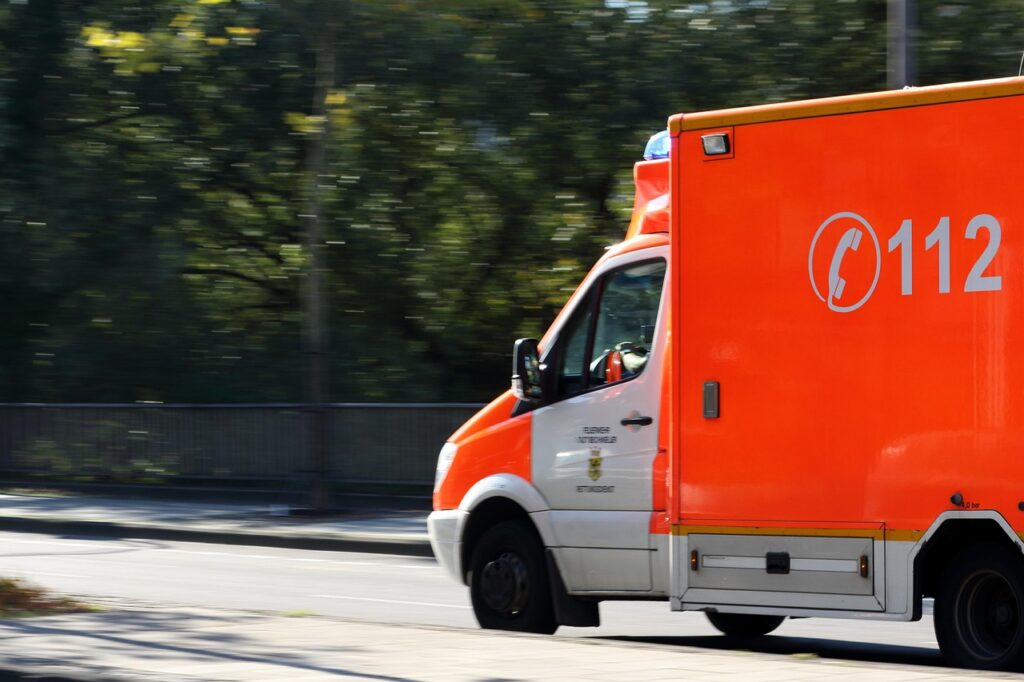
- Without insurance, a ground ambulance ride typically costs $500–$2,500, billed as a base rate plus a per-mile charge.
- An air ambulance (helicopter or fixed-wing) is far more expensive — commonly $25,000–$70,000 or more per transport.
- Two things drive the ground bill: BLS vs. ALS level of service, and loaded mileage to the hospital.
- In a real emergency, call 911 for an ambulance regardless of cost — do not delay care to save money.
- The No Surprises Act now protects you from surprise balance bills for air ambulances (and, in a growing number of states, ground ambulances too).
Without health insurance, a ground ambulance ride in the United States typically costs between $500 and $2,500, while an air ambulance (helicopter or airplane) commonly runs $25,000 to $70,000 or more. A ground bill is built from two parts — a flat base rate plus a per-mile “loaded mileage” charge — and rises with the level of medical care provided on board. Air transport is in a different universe of cost entirely.
First, the safety point that matters more than any price: if you are facing a real medical emergency, call 911 and take the ambulance. Paramedics deliver care the moment they reach you, and for conditions like stroke, heart attack, or major trauma, that head start saves lives. The money-saving guidance below is for non-emergency situations and for handling the bill afterward — never delay or refuse emergency transport to save money.
How much does an ambulance cost without insurance?
For a self-pay ambulance transport, expect a bill in the ranges below. These reflect typical 2026 U.S. prices; your bill will vary by provider (many are run by city fire departments or private companies), the level of care, and the distance traveled. Always ask the billing office for the self-pay or uninsured rate and whether a discount or hardship program applies.
| Scenario | Typical self-pay bill (2026) |
|---|---|
| Ground, basic life support (BLS), short trip | $500 – $1,200 |
| Ground, advanced life support (ALS), typical trip | $1,000 – $2,500 |
| Ground, long-distance or specialty transport | $2,500 – $5,000+ |
| Air ambulance (helicopter or fixed-wing) | $25,000 – $70,000+ |
To sanity-check an ambulance charge against typical rates in your area, FAIR Health Consumer publishes free estimates for ground and air transport, and Healthcare Bluebook offers fair-price benchmarks. For reference, Medicare pays ambulance providers only a few hundred dollars for a typical ground transport plus a modest per-mile rate — a useful floor that shows how much room can exist between the billed price and a reasonable one.
Ambulance cost: ground vs. air, and by mileage
A ground ambulance bill is almost always a base rate plus loaded mileage (the miles you are actually transported, not the miles the ambulance drove to reach you). The base rate depends on the level of service: BLS for routine care, ALS for advanced interventions like cardiac monitoring or IV medications. Air ambulances add an even higher base rate plus a much larger per-mile charge.
| Transport type | Typical base rate | Per-mile charge |
|---|---|---|
| Ground – BLS (basic life support) | $500 – $1,200 | $10 – $30/mile |
| Ground – ALS (advanced life support) | $1,000 – $2,000 | $15 – $40/mile |
| Air – helicopter (rotor-wing) | $20,000 – $40,000 | $100 – $300/mile |
| Air – airplane (fixed-wing, long distance) | $15,000 – $35,000 | $50 – $150/mile |
So a 10-mile ALS ground ride might be a $1,500 base plus $250 in mileage, landing around $1,750. A 50-mile helicopter transport can easily exceed $40,000 once the base rate and per-mile charge are combined — which is why air-ambulance bills are among the largest surprise medical bills people receive.
What determines the price of an ambulance ride
Five factors explain most of the variation between ambulance bills:
1. Ground vs. air — the biggest lever
Nothing else comes close. An air ambulance costs 10 to 50 times more than a ground ambulance. Air transport is used when time or terrain makes ground transport unsafe, but if a ground ambulance is medically appropriate, it will be a small fraction of the cost.
2. Level of service (BLS vs. ALS)
Advanced life support — cardiac monitoring, IV drugs, advanced airway management — carries a higher base rate than basic life support. The crew bills for the level of care they actually provide, not simply for the ride.
3. Loaded mileage
You’re charged per mile you are transported to the hospital. Longer distances, or being taken to a farther specialty center (a trauma or stroke center), raise the bill.
4. Who operates the service
Ambulances may be run by a municipal fire department, a hospital, or a private company, and their rates differ substantially. Some municipal services charge residents reduced rates or offer subscription programs.
5. Whether you ask for the self-pay rate and financial help
As with hospital bills, the uninsured “cash” price is often negotiable, and many providers — especially municipal ones — have hardship or income-based reduction programs. You usually have to ask.
Ground ambulance vs. air ambulance
The two are used for very different situations, and the cost gap is dramatic. This comparison is for understanding the bill — the choice of ground vs. air is a clinical decision made by 911 dispatchers and paramedics, not something you shop for in an emergency.
| Ground ambulance | Air ambulance | |
|---|---|---|
| Typical self-pay cost | $500 – $2,500 | $25,000 – $70,000+ |
| Used when | Most emergencies with road access | Remote areas, or when minutes are critical |
| Speed over distance | Standard | Fastest for long distances / difficult terrain |
| Surprise-billing protection | State-dependent (expanding) | Covered by the federal No Surprises Act |
If you’re ever offered a choice for a non-emergency transfer (for example, a scheduled transfer between facilities), it’s fair to ask whether ground transport is medically appropriate, because the savings are enormous. In an actual emergency, though, take whatever transport the responders determine you need.
7 ways to pay less for an ambulance without insurance
- In a real emergency, call 911 anyway — then handle the bill. Every step below applies after transport. Refusing an ambulance to save money can cost far more than any bill if it delays critical care.
- Know your No Surprises Act protection. The federal No Surprises Act bans surprise balance billing for air ambulances, so you generally can’t be charged out-of-network extra for one. Ground ambulances are increasingly protected at the state level — check your state’s rules, and dispute a balance bill that violates them.
- Tell the biller you’re uninsured and ask for the self-pay discount. Identify yourself as self-pay and ask for the reduced cash rate. Many ambulance providers will knock a meaningful percentage off the billed amount.
- Request an itemized bill and check the mileage. Ask for an itemized statement and verify the loaded mileage and level of service (BLS vs. ALS) are correct. Errors here directly inflate the total.
- Apply for hardship or financial-assistance programs. Municipal and hospital-affiliated ambulance services often have income-based reduction or hardship programs. Ask the billing office how to apply — this can substantially cut or eliminate the bill.
- Negotiate a lump-sum discount or a payment plan. Offer to settle for a reduced lump sum, or request an interest-free payment plan. Do this before the bill goes to collections, while you have leverage.
- Consider a subscription program if you’re high-risk. Some local ambulance services and air-medical companies sell low-cost annual “membership” plans that cap or waive your out-of-pocket cost for future transports — worth it if you have a condition that makes ambulance use likely.
When to prioritize care over cost
This is the most important section. Never let the price of an ambulance stop you from calling 911 in a genuine emergency. Call for an ambulance — do not drive yourself or wait — if you or someone near you has any of the following:
- Chest pain or pressure, or symptoms of a heart attack
- Sudden weakness, facial drooping, or trouble speaking (stroke signs)
- Difficulty breathing
- Severe bleeding, a major injury, or a suspected spinal injury
- Loss of consciousness, seizure, or sudden severe confusion
Paramedics begin treatment the instant they arrive and can safely move a critically ill or injured person in ways a private car cannot. Financial-assistance programs and surprise-billing protections exist precisely so that cost never has to enter the decision in a true emergency. The strategies in this guide are for non-urgent transport decisions and for negotiating the bill afterward.
Frequently asked questions
How much does an ambulance cost without insurance on average?
A ground ambulance typically costs $500–$2,500 as a self-pay patient, built from a base rate plus per-mile mileage. Air ambulances are far higher — commonly $25,000–$70,000 or more. Level of service and distance are the biggest ground-transport factors.
Why are ambulance bills so high?
Ambulance services bill a base rate for staffing and equipment plus a per-mile charge, and many operate independently of hospital networks, so a large share historically went out-of-network. Air transport is especially costly because of aircraft, crew, and 24/7 readiness. Always ask for the self-pay rate.
Does the No Surprises Act cover ambulances?
It covers air ambulances, protecting you from surprise out-of-network balance bills for them. Ground ambulances aren’t fully covered federally yet, but a growing number of states have their own protections. Check your state’s rules and dispute any bill that breaks them.
Do I have to pay for an ambulance if I refuse to go?
Sometimes. Some services charge a “treat and release” or response fee even if you decline transport, especially if paramedics evaluated or treated you. Ask before signing a refusal form — but never refuse genuinely needed care over a fee.
Is it cheaper to take an Uber or drive to the ER instead?
For a minor, non-emergency issue, yes — a car is far cheaper, and urgent care may be more appropriate than the ER at all. But for any potentially life-threatening symptom, call 911: an ambulance provides care en route and gets you to the right facility, which a rideshare cannot.
How can I lower an ambulance bill I already received?
Request an itemized bill and verify the mileage and level of service, tell the biller you’re uninsured and ask for the self-pay discount, apply for the provider’s hardship or financial-assistance program, and negotiate a lump-sum settlement or payment plan before it goes to collections.
Related reading: see how much an ER visit costs without insurance, when urgent care is the better-value choice, and browse the full Healthcare Costs guide for more ways to lower what you pay. See also endoscopy costs.
Prices in this article are typical 2026 self-pay ranges and vary by provider, level of service, and distance. In a real emergency, call 911 for an ambulance regardless of cost. Always request a written, itemized bill. This article is general information, not medical or financial advice.